
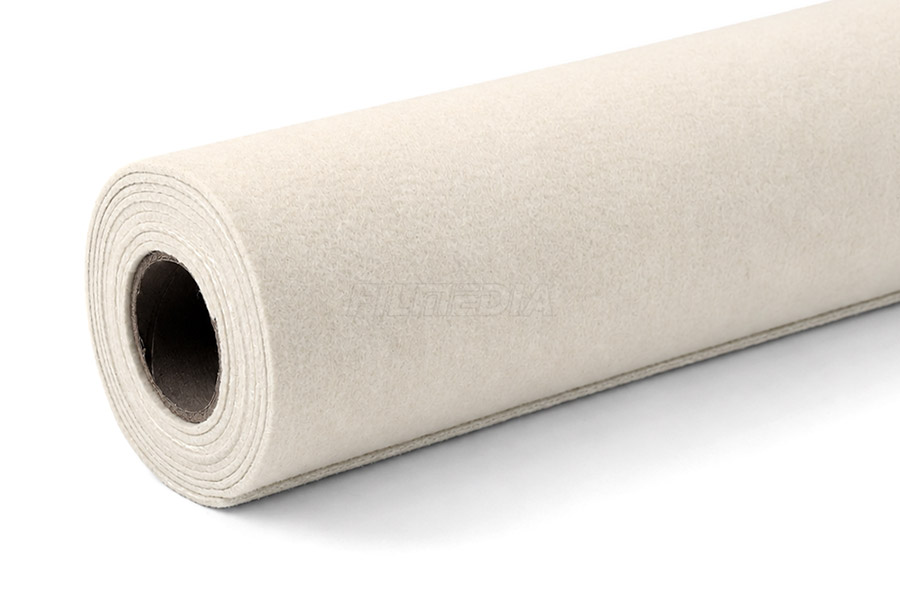
Fiberglass Needle Felt Filter Fabric
Due to its three-dimensional high porosity, gas flow resistance is significantly reduced. At an equivalent pressure drop, its filtration velocity (air-to-cloth ratio) is approximately twice that of ordinary woven filter media, substantially increasing the processing capacity of a single dust collector.
Utilizing a deep-bed filtration and microporous interception mechanism, its collection efficiency for ultra-fine dust and sub-micron particles (like carbon black) far exceeds that of woven alternatives. This makes it highly effective for severe dust pollution control and the recovery of valuable fine particles.
Made from pure E-glass fibers, it possesses inherent flame-retardant and fireproof properties. It sustains a continuous working temperature of 240°C to 260°C, with instantaneous peaks exceeding 280°C.
It maintains the near-zero thermal shrinkage rate characteristic of fiberglass. Even under long-term exposure to high temperatures and corrosive acid/alkali environments, it retains superior wear, flex, and mechanical tensile resistance.
Description
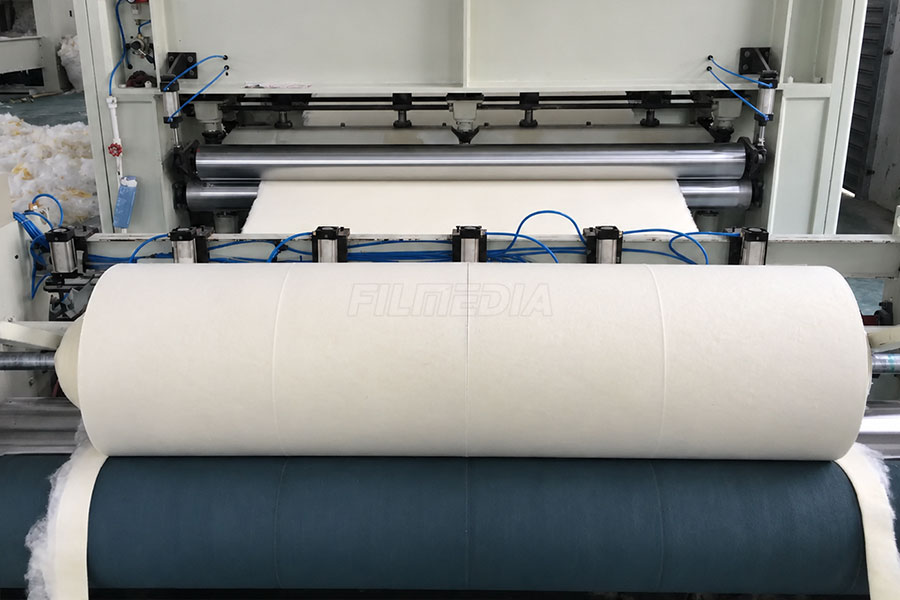
Fiberglass needle-punched felt is a high-temperature filtration material manufactured using alkali-free (E-glass) fiberglass as the primary raw material through a needle-punching process. It combines the excellent high-temperature and corrosion resistance of fiberglass with the high porosity and low flow resistance characteristic of needle-punched nonwoven structures. Widely used for industrial high-temperature flue gas dedusting and dust recovery, it serves as a critical filtration medium in bag-type dust collection systems across industries such as carbon black, iron and steel metallurgy, cement, power generation, and chemicals.
Physical Properties of Fiberglass Needle Felt
| Weight(gs m) | 850 | |
| Thickness(mm) | 2.5 | |
| Width(m) | ≤2.2 | |
| Finish treatment | Singeing, Calendering, Heat setting | |
| Air permeability(L/m2.s) | 200-350 | |
| Tensile strength(N/5cm) | warp | ≥900 |
| weft | ≥1050 | |
| Tensile elongation(%) | warp | ≤35 |
| weft | ≤60 | |
| Heat shrinkage(%) | warp | ≤1.5 |
| weft | ≤1.0 | |
| Temperature(°C/°F) | Continue | 240/464 |
| Instant | 280/536 | |
| Anti-acid | Excellent | |
| Anti-alkali | Excellent | |
| Anti-abrasion | Excellent | |
| hydrolysis stability | Good | |
Post-processing
Due to the inherently brittle nature and lack of elasticity of glass fibers, the felt material must undergo advanced surface chemical treatment or fiber blending modification to withstand complex and harsh industrial flue gas conditions.
☑ Chemical Impregnation (Silicone Oil / Graphite / PTFE Emulsion)
A protective coating is formed on the fiber surface to reduce mechanical friction between fibers, effectively overcoming the inherent brittleness and poor flex resistance of fiberglass. This treatment significantly extends the flexing and service life of filter bags.
☑ Singeing & Calendering
Surface fuzz is removed through singeing, followed by heat and pressure calendering to create a smoother surface. This facilitates dust cake release during pulse-jet cleaning, improves cleaning efficiency, and reduces operating resistance.
☑ PTFE Membrane Lamination
A microporous PTFE membrane is laminated onto the surface of the needle felt, upgrading filtration from depth filtration to surface filtration. This enables near-zero emission performance with extremely high filtration efficiency while making dust cake removal much easier.
☑ Inorganic Binder Impregnation & Hot Pressing
For specific thermal insulation, heat preservation, or dimensional stabilization requirements, the filter media can be treated with inorganic binders and hot pressing to reinforce the structural integrity and maintain the desired shape under demanding operating conditions.
Fiberglass Blend Needle Felt
In the realm of high-performance industrial filter media, while pure glass fiber needle-punched felt is excellent, it suffers from a critical physical drawback: high brittleness and poor flexural resistance. Under the high-frequency mechanical stress of pulse-jet cleaning—which causes the filter bag to expand and snap back violently—pure glass fibers are highly prone to fatigue failure, leading to bag damage. To address this issue, the industry developed a “blending” process that combines glass fibers with highly elastic, abrasion-resistant synthetic fibers, thereby leveraging the complementary strengths of each material.
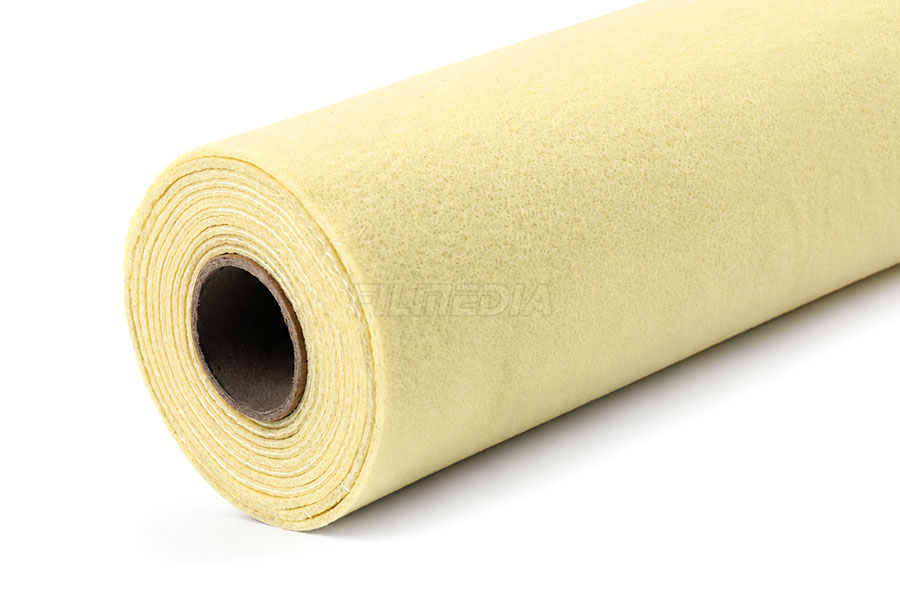
Blended with P84 (Polyimide)
P84 fibers feature a unique, irregular trilobal cross-section that significantly increases the filtration surface area. Blending with P84 markedly improves the filter medium’s dust collection efficiency, resistance to flex fatigue, and pulse-jet cleaning performance.
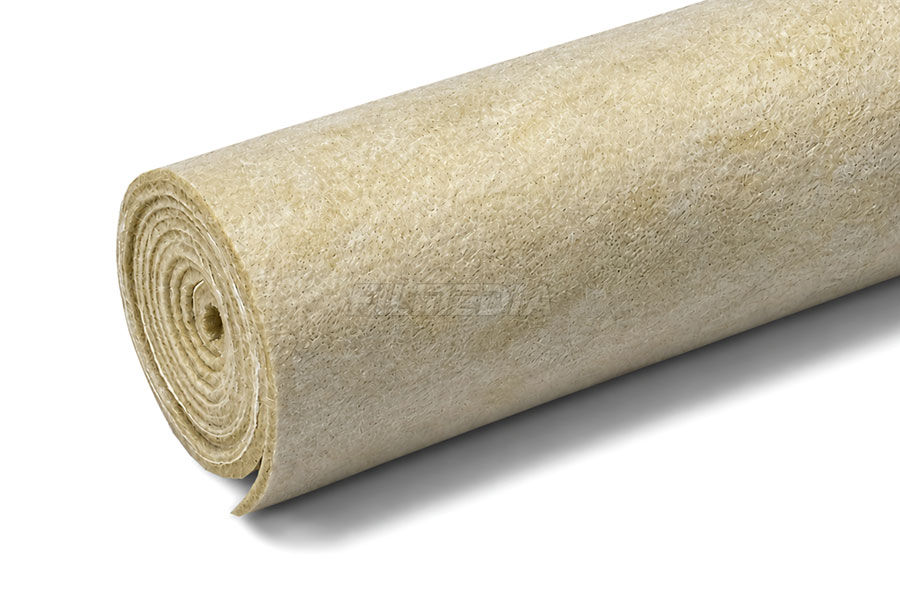
Blended with Nomex (Aramid)
Nomex imparts excellent abrasion resistance, flex-fatigue resistance, and structural stability at high temperatures to the filter medium, effectively preventing mechanical fatigue and breakage of the glass fibers during high-pressure pulse-jet cleaning.