
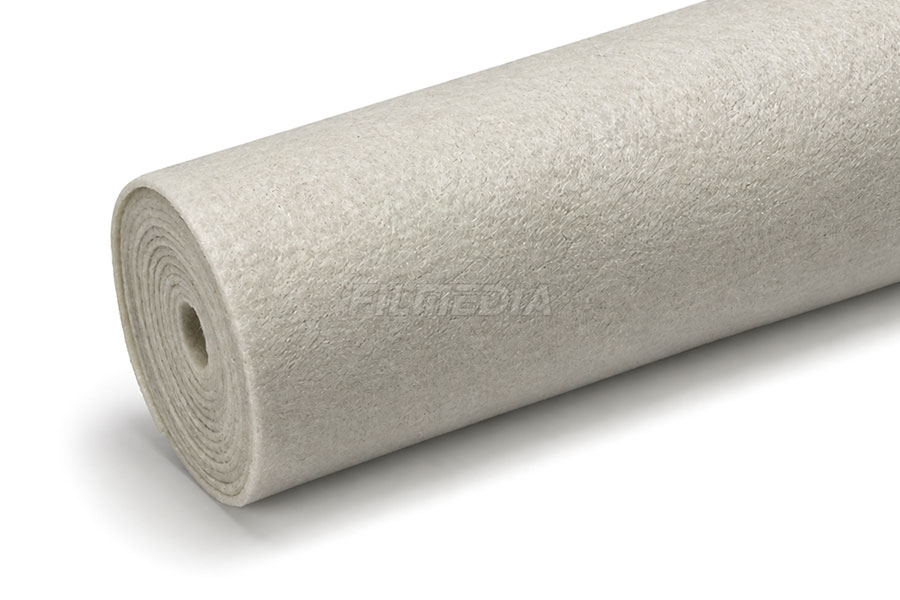
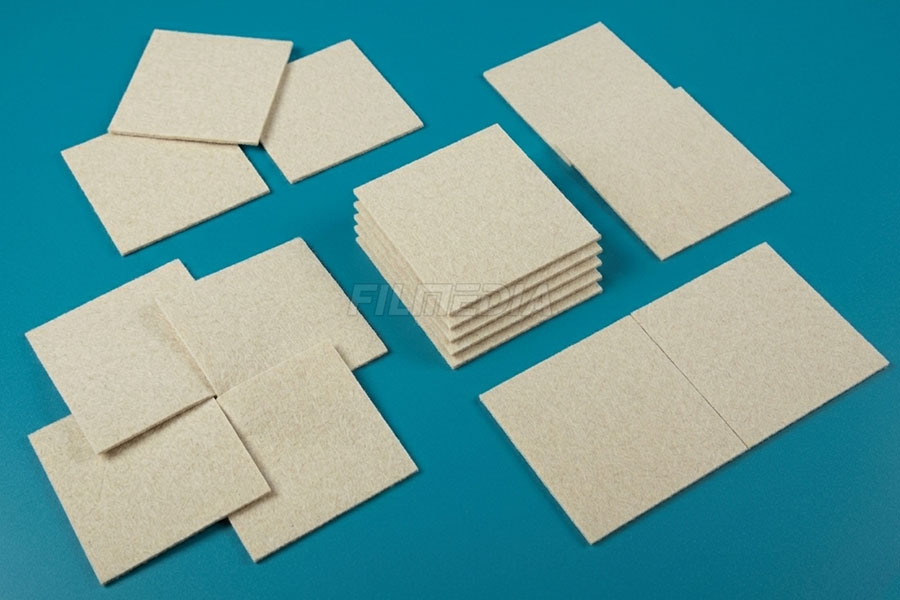
PPS (Ryton) Needle-Punched Felt Filter Fabric
With its excellent heat resistance, superior chemical resistance, high mechanical strength, and stable filtration performance, PPS needle felt has become one of the most widely used filter media for medium- and high-temperature industrial dust collection systems.
PPS fibers exhibit outstanding resistance to acids and alkalis, maintaining stable performance in environments containing corrosive gases such as SO₂, SO₃, and NOx. Their chemical resistance is significantly superior to conventional polyester filter media, making them particularly suitable for coal-fired boilers and waste incineration applications.
- Continuous operating temperature: 160–190°C.
- Peak operating temperature: 190–220°C.
- Melting point: approximately 285°C.
PPS fibers offer excellent tensile strength and abrasion resistance, enabling the filter media to withstand repeated pulse-jet cleaning cycles and extending filter bag service life.
The three-dimensional porous structure created by the needle-punching process provides a large effective filtration area for efficient particle capture. Surface treatments such as singeing, calendering, and PTFE membrane lamination further improve dust release properties and reduce operating pressure drop.
Description
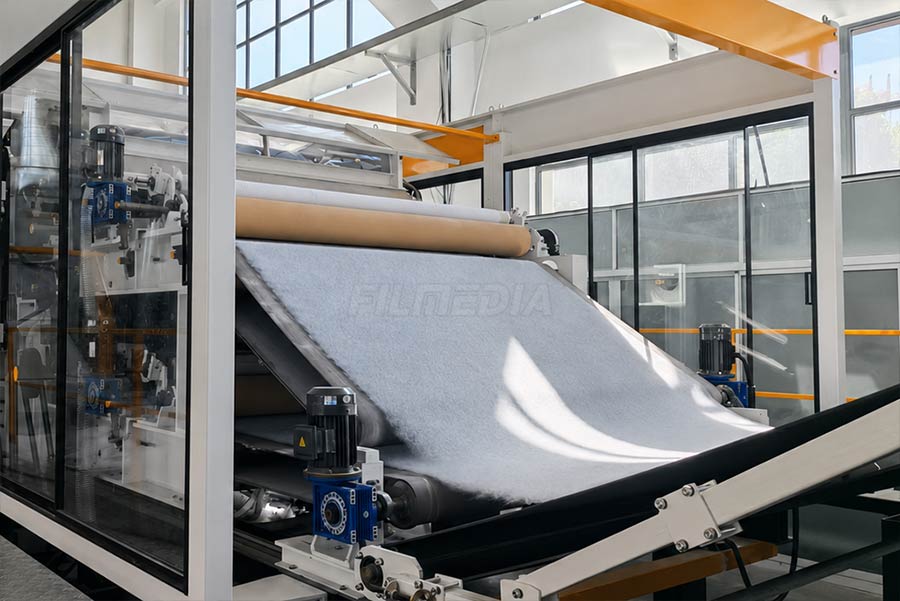
As a manufacturer of premium needle-felt filtration materials, Filmedia® leverages extensive industry experience and a team of technical experts to gain a deep understanding of filtration requirements across diverse operating conditions. We provide scientifically sound, practical, and reliable filtration solutions tailored to our customers’ specific applications. Our comprehensive technical support—encompassing material selection, product design, and process optimization—aims to enhance filtration efficiency, extend product service life, and reduce overall operating costs.
Physical & Chemical Properties of PPS (Ryton) Needle Felt
| Item | Specification |
|---|---|
| Weight | 500 g/m² |
| Thickness | 1.8 mm |
| Air Permeability | 8–12 m³/m²·min |
| Breaking Strength (Warp) | >800 N/5×20 cm |
| Breaking Strength (Weft) | >1000 N/5×20 cm |
| Tensile Elongation (Warp) | <25% |
| Tensile Elongation (Weft) | <45% |
| Continuous Working Temperature | <190°C |
| Short-Term Working Temperature | 210°C |
| Acid Resistance | Excellent |
| Alkali Resistance | Excellent |
| Abrasion Resistance | Excellent |
| Hydrolysis Resistance | Excellent |
Structure and Working Principle
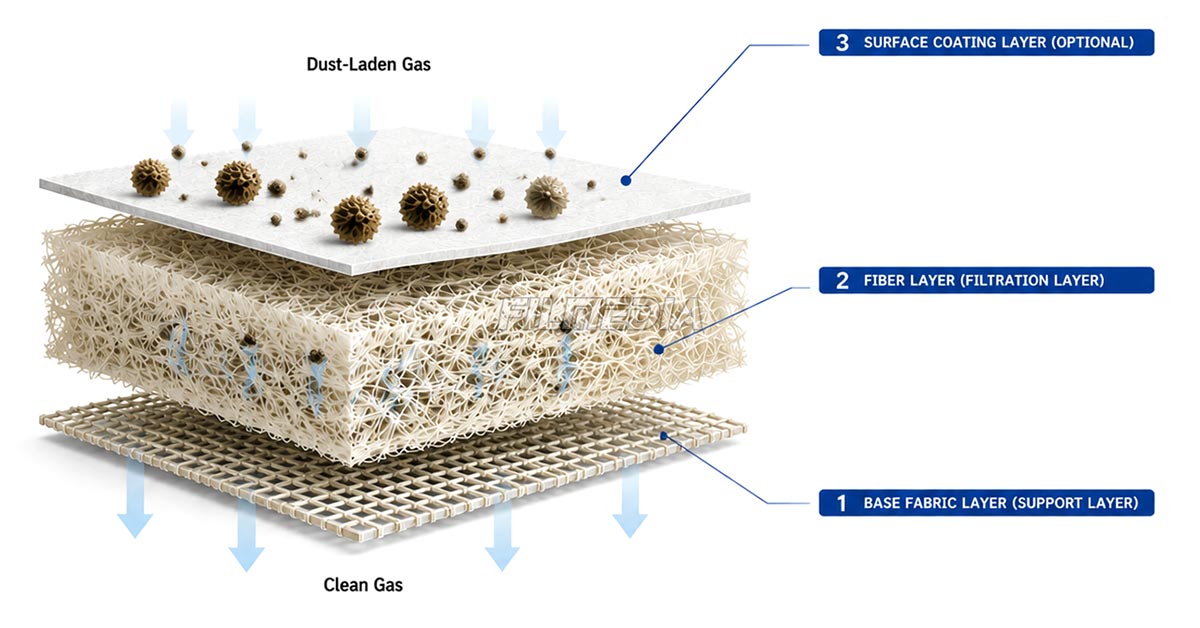
01. Material Composition
- Base Fabric Layer
Uses fiberglass or PTFE (polytetrafluoroethylene) reinforcing mesh to provide mechanical support.
- Fiber Layer
Formed from PPS staple fibers via a needle-punching process, constituting the primary filtration medium.
- Surface Membrane (Optional)
Optional PTFE membrane or other functional coatings to enhance filtration efficiency or abrasion resistance.
02. Dust Cleaning Principle
PPS needle-punched felt utilizes a mechanism combining depth filtration and surface filtration. As dust-laden gas passes through the filter medium, larger particles are directly intercepted, while finer particles are captured through mechanisms such as inertial impaction, the sieving effect, diffusion, and electrostatic attraction. Over time, a stable dust layer gradually forms on the surface of the filter medium, further enhancing filtration efficiency. Following pulse-jet cleaning, the dust layer is dislodged, restoring the filter bag to a lower operating resistance and enabling continuous, high-efficiency operation.
Common Post-Processing Techniques
☑ Singeing & Calendering
Removes surface fuzz and flattens the filter material surface, reducing dust embedment and improving dust-cleaning performance.
☑ Heat Setting
Relieves internal stress, enhances dimensional stability, and minimizes shrinkage or deformation at high temperatures.
☑ Water and Oil Repellent Treatment
Lowers the surface energy of the filter material to prevent moisture- or oil-laden dust from causing caking or blinding (blinding of the filter bag).
☑ PTFE Impregnation
Allows PTFE emulsion to penetrate the fibers and form a protective layer on their surface, further enhancing corrosion and oxidation resistance.
☑ PTFE Membrane Lamination
Laminates a microporous PTFE membrane onto the filter media surface, upgrading the process from traditional depth filtration to surface filtration.
Membrane Lamination Enhances Filtration Precision
To further enhance filtration precision, PPS needle-punched felt often employs surface lamination technology. PTFE lamination creates a dense microporous structure that effectively captures sub-micron particles.
| Parameter | Standard PPS Needle Felt | PTFE Membrane-Laminated PPS |
|---|---|---|
| Minimum Captured Particle Size | 1.0 μm | 0.3 μm |
| Filtration Efficiency | ≥99.5% | ≥99.9% |
| Dust Release Performance | Good | Excellent |
| Operating Resistance | Standard | Lower |
Application Industries
In applications involving sulfur-containing flue gases, high humidity, and corrosive environments, PPS needle felt filter bags treated with PTFE impregnation or PTFE membrane lamination can significantly enhance filtration efficiency and service life, providing a reliable solution for industrial air pollution control and ultra-low emission compliance.
- Suitable for dust removal from coal-fired boiler exhaust; exhibits excellent acid resistance, particularly in high-sulfur coal applications.
- Resistant to corrosive gases such as HCl and SOx; serves as a key filtration material for waste incineration flue gas treatment.
- Used in dust removal systems for sintering machines, iron-making blast furnaces, converters, and electric arc furnaces.
- Suitable for high-temperature dust removal in kiln inlet, kiln outlet, and coal grinding systems.
- Used in purification systems for acidic gases, corrosive dust, and chemical industry exhaust.
- Suitable for filtering high-temperature, corrosive flue gas generated during the smelting of metals such as lead, zinc, and copper.