
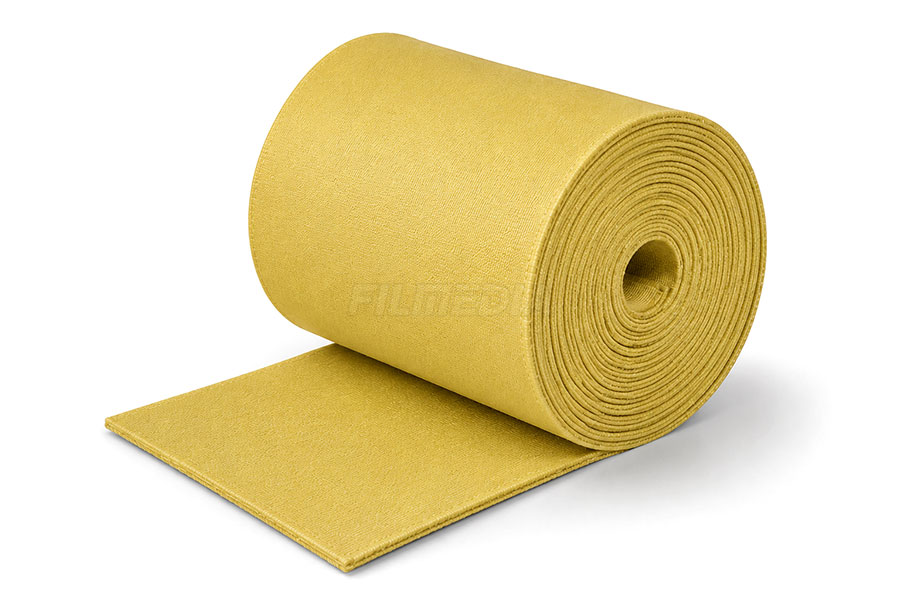
In industrial applications, aramid air slide fabric (aramid air slide canvas) has become a preferred material for many industries due to its excellent heat resistance, abrasion resistance, and air permeability. Aramid fibers are known for their high strength, low density, outstanding corrosion resistance, and inherent flame-retardant properties. This unique combination of performance makes them an indispensable material in high-temperature pneumatic conveying systems.
- The max. length per roll: 50 M.
- Max Width: 2.6 M.
- Thickness: 4~10 MM.
- Heat-resistant: ≤260 ℃.
Description
Filmedia® air slide fabrics are manufactured from premium synthetic fibers using advanced integral weaving technology to provide reliable performance under demanding industrial conditions.
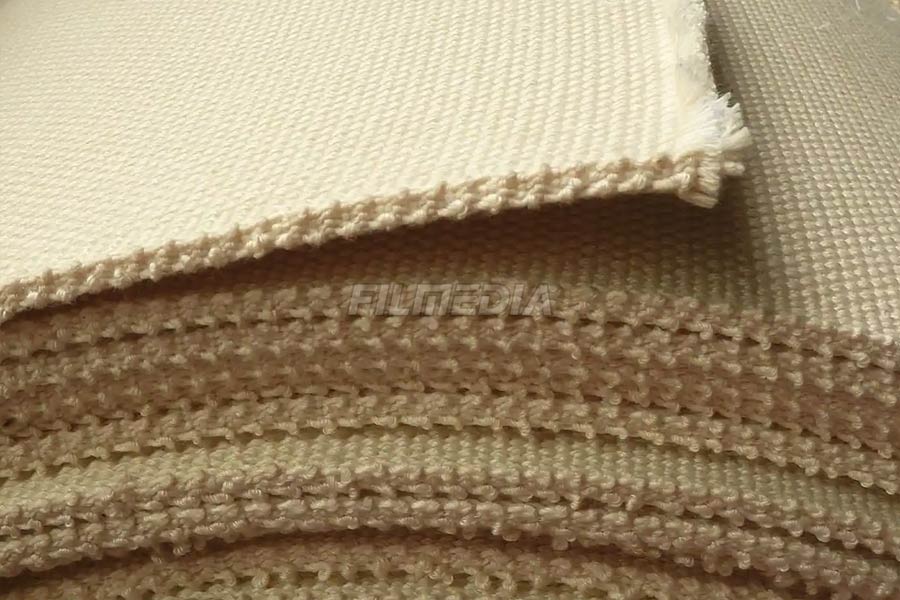
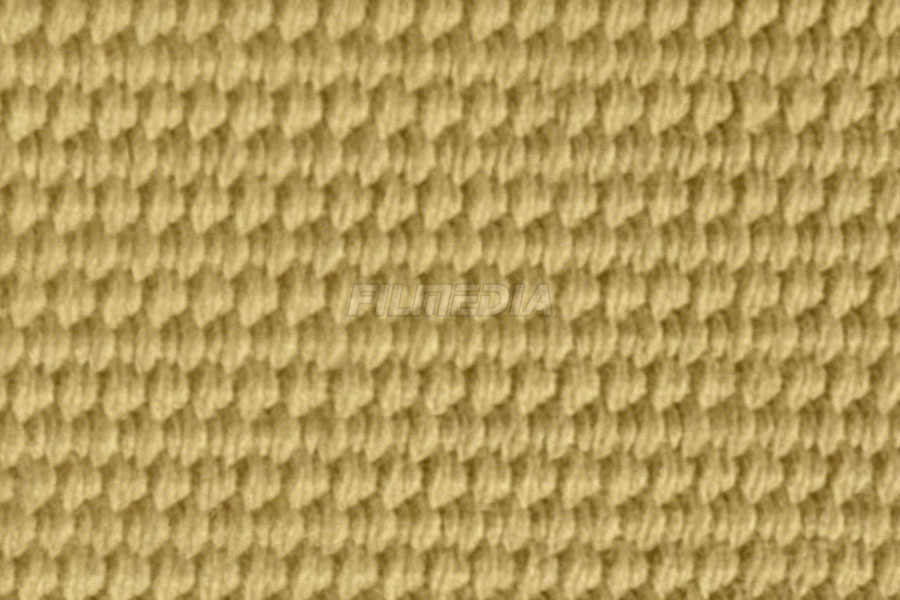
Aramid air slide canvas are primarily used as a supporting and air-permeable layer in inclined air slide chutes and storage hopper outlets for conveying dry powdered materials. It is widely applied in industries such as thermal power plants, alumina processing, bauxite handling, soda ash production, gypsum processing, and flour conveying. It is especially suitable for horizontal conveying systems and fluidization operations in silo discharge applications.
Outstanding Advantages
☑ Exceptional High-Temperature Performance
Capable of stable, continuous operation over long periods at temperatures up to 250°C, with the ability to withstand even higher temperatures momentarily. It overcomes the issues of burn-through and degradation common to standard materials (such as polyester) when handling extremely hot substances—such as materials in cement clinker firing systems or fly ash from steel blast furnaces.
☑ Uniform Air Permeability
The physical pore distribution on the surface of the aramid fibers is exceptionally uniform, allowing compressed air to permeate evenly across the entire surface. This ensures excellent material fluidization and completely eliminates issues such as flow obstruction, caking, and chute blockages caused by uneven airflow.
☑ Superior Wear Resistance
The surface resists fuzzing, thinning, and damage even under the long-term erosive impact of high-velocity, hard powders (such as alumina and cement clinker), resulting in a service life several times longer than that of standard aeration fabrics.
☑ Chemical Corrosion Resistance
Aramid fibers exhibit exceptional chemical inertness against acids, alkalis, organic solvents, and industrial exhaust gases. They maintain excellent mechanical strength even in complex operating environments—such as chemical processing or environmental desulfurization systems—where corrosive gases are present.
Specification of Nomex Air slide Fabric
| Type | Material | Tensile strength kg/40mm | Thickness(mm) | Air permeability(m3/ m2. min) | Temperature(℃) | Weight(kg/m2) |
| FM-A-6.5 | Aramid 1313 | ≥500 | 6.5 | 1.8 | ≤240℃ | 4.2 |
| FM-A-6 | Aramid 1313 | ≥500 | 6 | 2 | ≤240℃ | 4 |
| FM-A-5.5 | Aramid 1313 | ≥500 | 5.5 | 2.3 | ≤240℃ | 3.8 |
| FM-A-5 | Aramid 1313 | ≥500 | 5 | 2.8 | ≤240℃ | 3.6 |
| FM-A-6 | Aramid 1414 | ≥600 | 6 | 2 | ≤260℃ | 4.2 |
| FM-A-6 | Aramid 1414 | ≥550 | 5 | 3 | ≤260℃ | 3.6 |
Postscript: Tolerance of thickness: +/- 0.3mm , gram weight: +/- 5%, air permeability: +/- 10%.
How Does It Work?
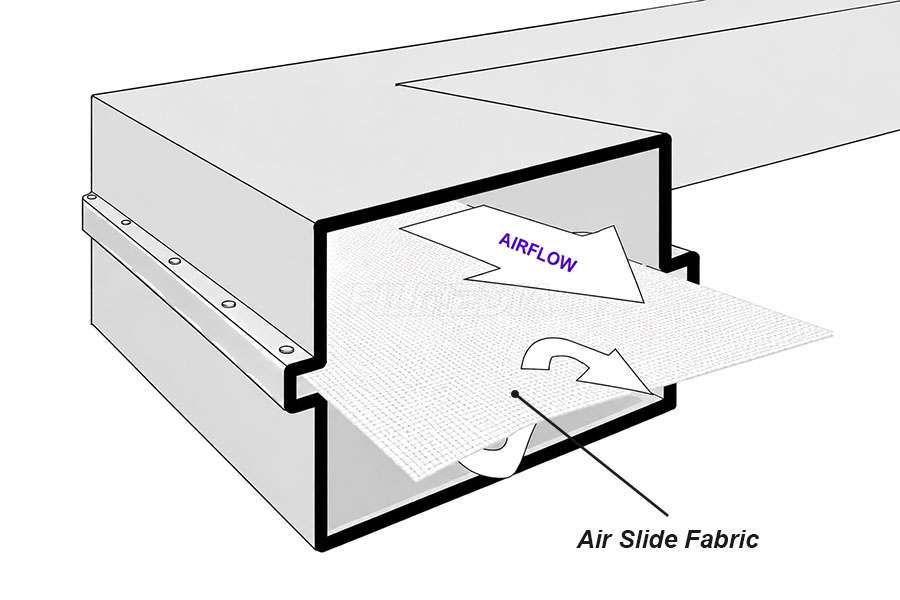
Air slide fabric is installed between the upper and lower channels of air slides to separate two cavities. High-pressure air fills the lower channel and penetrates evenly through the polyester air slide fabric into the upper channel. The dry powdery materials on top of the fabric are fluidized by uniform airflow, then flow smoothly relying on gravity to realize continuous pneumatic conveying.
Aramid 1313 or Aramid 1414
The two materials can be selected based on specific operating conditions to achieve the optimal balance between performance and cost.
Aramid 1313 (Meta-Aramid)
Offers superior wear resistance and thermal stability, making it ideal for high-abrasion and high-temperature material handling.
Aramid 1414 (Para-Aramid)
Focuses more on high tensile strength and chemical stability, allowing it to perform exceptionally well in corrosive or high-pressure industrial scenarios.