
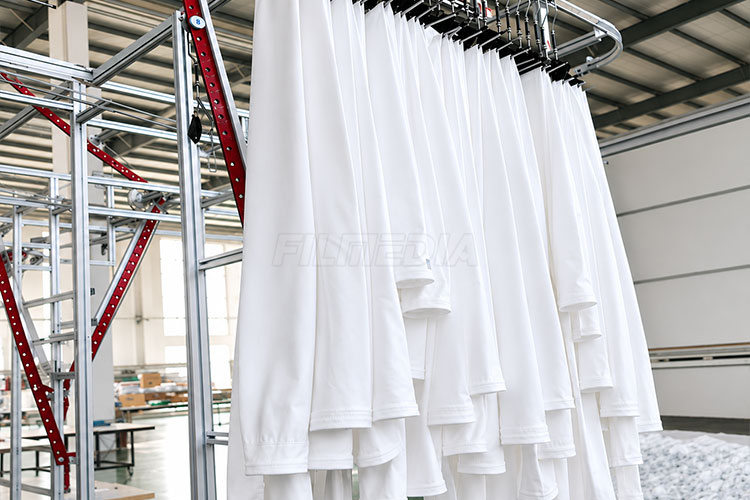
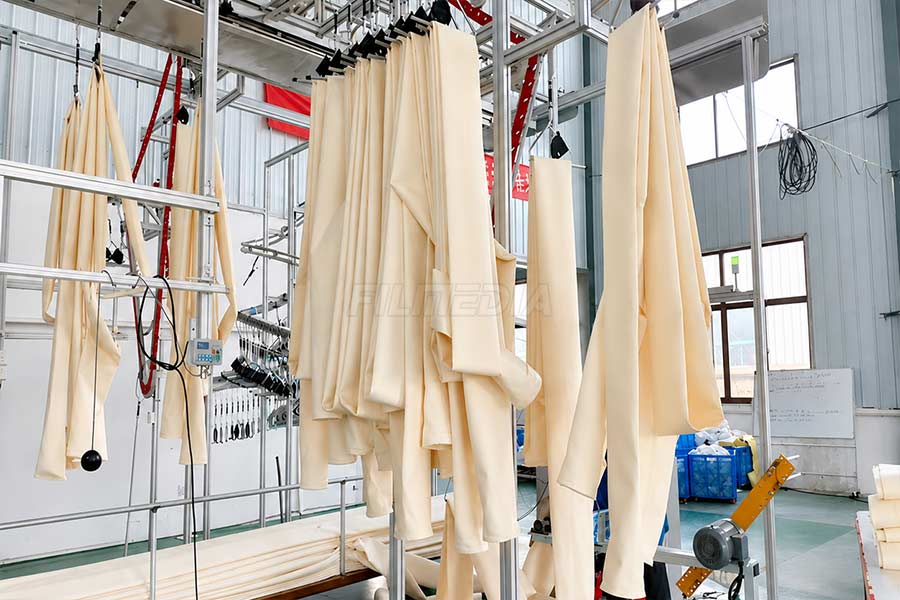
A PTFE membrane filter bag is an advanced filtration medium engineered by thermally laminating a micro-porous polytetrafluoroethylene (PTFE) film onto the surface of a standard filter substrate. This ultra-thin membrane functions as a permanent “primary dust layer.” Unlike conventional media, dust separation occurs entirely on the outer surface of the membrane from the very first operational cycle, establishing highly efficient filtration immediately upon deployment.
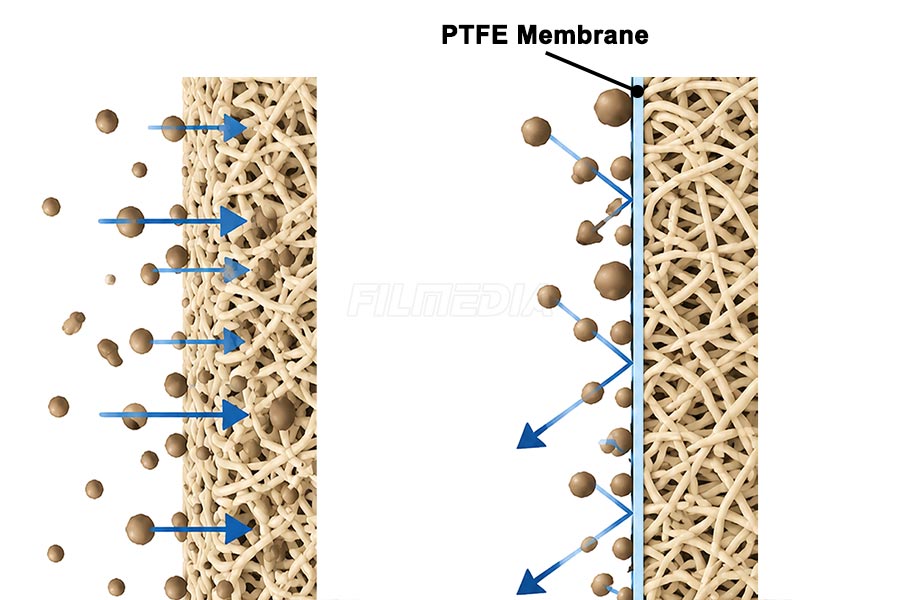
Characterized by a unique three-dimensional, interconnected porous structure, the PTFE membrane completely blocks fine particulates from penetrating into the substrate, eliminating the risk of internal pore clogging and drastically reducing particulate emissions. This mechanism is industry-defined as “Surface Filtration.”
Beyond achieving near-zero emissions, the inherently non-stick properties and low friction coefficient of the PTFE membrane allow the accumulated dust cake to dislodge effortlessly during cleaning. This ensures long-term stability of the system’s differential pressure (resistance), allowing baghouses to maximize their operational efficiency. Consequently, PTFE membrane media represents the premium choice for modern industrial air filtration.
Core Advantages of PTFE Membrane Filter Bags
1. Transition from Deep-Bed to True Surface Filtration
- Traditional Media: Standard industrial baghouses typically rely on “deep-bed filtration,” where effective particulate capture is only achieved after a stable dust cake forms on and within the fabric. This initial seasoning period can consume up to 10% of the total filtration cycle, during which emission levels are elevated, pressure drop is high, and filtration efficiency is compromised. This results in frequent pulse-jet cleaning, high energy consumption, shortened bag life, and a larger equipment footprint.
- PTFE Membrane Media: In contrast, the micro-porous membrane prevents dust from entering the cross-section of the bag. Whether managing coarse particles or sub-micron fines, all contaminants are intercepted at the boundary surface. This eliminates the initial seasoning period, delivering maximum filtration efficiency instantaneously.
2. Extended Service Life and Cost-Effectiveness
PTFE membrane-coated media exhibits outstanding mechanical and chemical properties across all types of pulse-jet and reverse-air cleaning systems. The membrane structure is engineered to be both flexible and highly resilient, offering excellent tensile strength and fatigue resistance. Combined with its superior dust-release capability, the medium significantly lowers the required intensity and frequency of pulse-jet cleaning. Operating under a consistently low and stable differential pressure minimizes mechanical wear and tear, substantially extending the service life of the filter bags and lowering total cost of ownership.
3. Low Operational Resistance and Continuous High-Throughput
- The Conventional Clogging Loop: Once traditional deep-bed filtration media goes online, dust particles inevitably penetrate deep into the fibers. Over time, these trapped particles cause irreversible depth-clogging (blinding), which severely restricts air permeability and drives up system resistance.
- The PTFE Advantage: Featuring sub-micron pore sizes and high porosity, the PTFE membrane maintains near-zero dust transmittance while delivering exceptional initial airflow capacity. As the dust cake on the membrane surface reaches a certain thickness, it naturally sloughs off due to gravity and low surface energy. This outstanding cleanability keeps the operational pressure drop at a minimal level and maintains a high, stable volumetric airflow, enabling uninterrupted, continuous production.
4. Optimized and Simplified Cleaning Cycles
The operational pressure drop of a filter baghouse directly depends on the residual dust remaining on the media after a cleaning cycle. PTFE membrane filter bags require significantly shorter pulse-jet durations (often lasting only a few seconds) yet achieve unmatched cleaning efficiency. Because each pulse effectively clears the surface dust cake without allowing internal entrapment, the fabric’s original porosity and mass density remain unaltered over years of operation, sustaining low-resistance performance.
How to Choose the Right PTFE Membrane Filter Bag for Your Operating Conditions
The base fabric determines the filter bag’s temperature resistance, chemical resistance, mechanical strength, and overall service life. Filmedia® offers a complete range of PTFE membrane filter bags by laminating an expanded PTFE membrane onto different needle felt substrates, providing reliable filtration solutions for industrial flue gas applications ranging from low-temperature dust collection to extreme high-temperature and corrosive environments.
1. PPS Needle Felt + PTFE Membrane
Ideal for Acidic Flue Gas and Coal-Fired Applications
Base Fabric Characteristics
PPS (Polyphenylene Sulfide) needle felt offers outstanding resistance to acids, alkalis, and most chemical corrosive media. It provides continuous operating temperatures of approximately 160°C to 190°C, while maintaining excellent dimensional stability and filtration performance.
Typical Applications
PPS PTFE membrane filter bags are widely used in:
- Coal-fired boilers
- Waste incineration plants
- Thermal power stations
- Coal-fired industrial furnaces
These applications typically contain high concentrations of sulfur compounds and acidic gases. The PTFE membrane further enhances fine particle capture while preventing dust penetration and minimizing bag blinding caused by acidic condensation, making this combination one of the most cost-effective solutions for corrosive flue gas filtration.
2. Fiberglass Needle Felt + PTFE Membrane
Designed for Extreme High-Temperature Filtration
Base Fabric Characteristics
Fiberglass needle felt provides exceptional heat resistance with continuous operating temperatures of 240°C to 260°C. It features excellent dimensional stability with virtually no stretching or shrinkage under heat, while remaining a cost-effective option for high-temperature applications. Although fiberglass has lower flex fatigue resistance than synthetic fibers, it performs exceptionally well under stable operating conditions.
Typical Applications
Ideal for:
- Cement kiln inlet and outlet dust collection
- Blast furnace gas filtration in steel plants
- High-temperature chemical processing
- Metallurgical exhaust systems
For high-temperature, relatively stable operating environments with minimal mechanical flexing, fiberglass PTFE membrane filter bags remain one of the industry’s preferred solutions.
3. P84 Needle Felt + PTFE Membrane
High-Efficiency Filtration for Fine Dust
Base Fabric Characteristics
P84 (Polyimide) fibers feature a unique irregular trilobal cross-section that provides an exceptionally large specific surface area, resulting in outstanding filtration efficiency. With continuous operating temperatures up to 240°C, P84 also offers superior oxidation resistance compared with PPS.
Typical Applications
Recommended for:
- Waste incineration plants
- Asphalt mixing plants
- Cement kilns
- Smelting and metallurgical processes
The combination of P84’s inherently high filtration efficiency and the PTFE membrane’s surface filtration creates an excellent solution for achieving ultra-low emission standards while effectively capturing high concentrations of submicron dust particles.
4. Polyester (PET) Needle Felt + PTFE Membrane
Economical Solution for Ambient Temperature Applications
Base Fabric Characteristics
Polyester (PET) needle felt is the most widely used filter media for applications below 130°C. It offers high tensile strength, excellent abrasion resistance, and low cost. However, polyester is susceptible to hydrolysis in high-humidity environments.
Typical Applications
Suitable for:
- Flour milling
- Wood processing
- Cement grinding systems
- Pharmaceutical manufacturing
- Ambient-temperature steel plant dust collection
In dry, low-temperature environments without significant moisture or elevated temperatures, polyester PTFE membrane filter bags provide excellent dust release, high filtration efficiency, and low operating costs.
5. Aramid Needle Felt + PTFE Membrane
Superior Abrasion and Mechanical Strength
Base Fabric Characteristics
Aramid (Nomex®-type) needle felt provides continuous operating temperatures up to 200°C while delivering excellent abrasion resistance, flex resistance, and mechanical strength. It performs particularly well under demanding operating conditions involving high dust loading and frequent pulse cleaning. However, it is less suitable for strong acidic environments and prolonged hydrolysis exposure.
Typical Applications
Commonly used in:
- Asphalt mixing plants
- Cement kiln baghouses
- Metallurgical dust collection systems
Aramid PTFE membrane filter bags are particularly suitable for applications involving frequent temperature fluctuations, highly abrasive dust, and severe mechanical wear, where durability and long service life are essential.